





The fourth period is the 90 minute block designated for Social and Emotional Learning slideshows, independent study, additional class instruction, or a prompt nap, all depending on who you’re asking. It’s clear this block houses a wide array of functions and necessities. Even so, administrators and select staff, regarded as a “focus group,” have been working to bring back a vital part of Hawk Time 4: SOARing out. The goal is to strike a balance between offering additional educational support and maintaining student accountability.
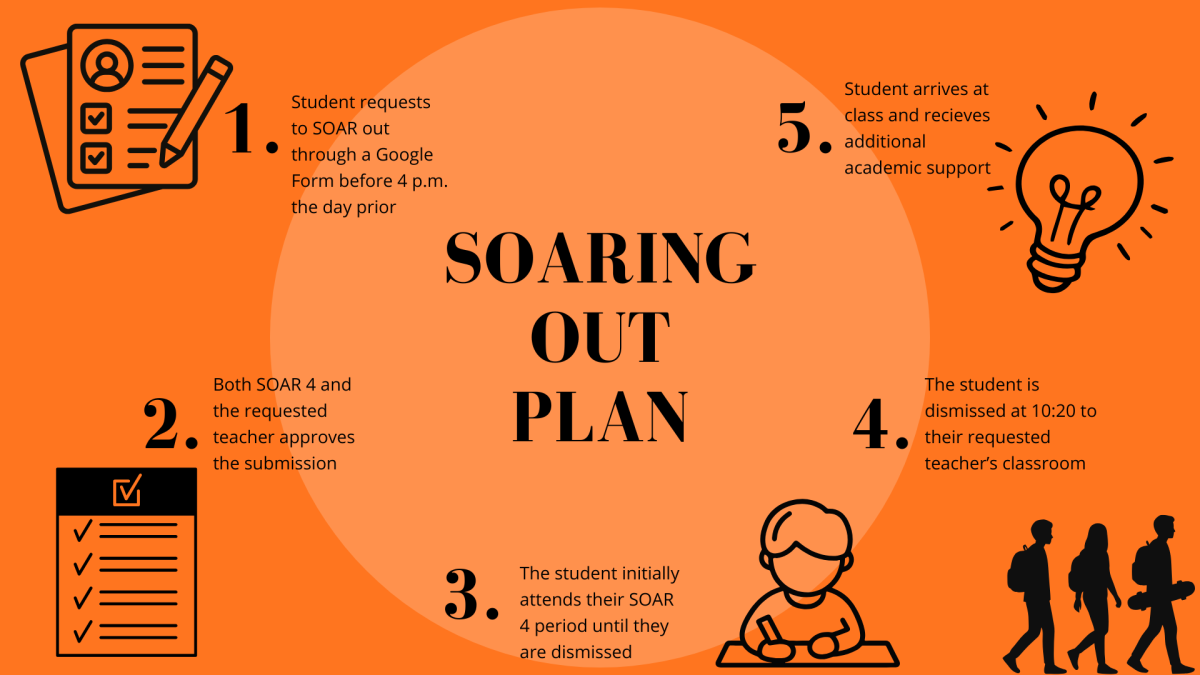
Jan. 21 marked the start of Hayfield’s new “SOARing out Plan,” where seniors were allowed to SOAR out as long as they submitted a request in a Google form, and both their Hawk Time 4 and requested teacher confirmed their request in a master spreadsheet. This new management of Hawk Time 4 allows students to be able to participate in all of the mental and emotional coping practices offered in SEL from 9:35-10:20 while also getting caught up on work in other classes from 10:25-11:05.
However, the opportunities to use this system are limited. The rollout comes in phases: seniors are allowed to SOAR out in January and onward, juniors on Feb. 18, sophomores on Feb. 24, and freshmen on March 10. Middle school is predicted to start in March after the high school side’s entire rollout, but no dates have been declared. Furthermore, for those who are eligible, this SOAR opportunity is available during the last 45 min of SOAR 4, which is once every school week.
“The reason we’re rolling it out slowly like with seniors first and juniors is because we want to see if there’s any flaws,” Casey Quigley, middle school assistant principal, said.
Starting the new program with a smaller group of students allows the administration to get feedback on problems and reevaluate without a scaling of the potential conflict. Administration’s commitment to a thorough collection of surveys sets the program up for long-term success. But these strides are defined and affirmed through multiple different lenses. Yes, students will now begin to have an additional resource during the school day to help them academically, but administrators and teachers will also now be equipped with the means of organizing and keeping track of those SOARing out. Ultimately, this careful planning is built on the goal of balancing and prioritizing both student independence and safety.
“Even one student being unaccounted for, to me, is too many because how do I tell that parent, ‘I don’t know where your kid is?’” Quigley said. “It’s certainly not something I want anyone to tell me about my children.”
Having these distinct, more organized block schedules also consolidates a single schedule that works for both the high school and middle school as grades seven and eight use the block for various interventions: math, reading, writing, and science.
“Some kids can be assigned to a literacy class, but others that needed additional literacy support needed another time where they could get that extra support, and so that period four class allows us to do what we call interventions,” Quigley said.
The meticulous crafting of the system fits a variety of needs, spanning grades 7-12. This level of thought and consideration for each person in the building had been made possible by a “focus group.” Specifically, these voices are various school faculty members, such as System of Support Advisors, School-Based Technology Specialists, and librarians.
“It’s important to get other people’s perspective because, as an administrator, my lens of what happens in school and what [a teacher’s] perception of what happens in school could be very different and how we experience things is different, so you want to hear from everyone so you come up with a system that may not be perfect for everybody, but it works for everybody,” Quigley said.
Of course, organizing a middle and high school is not linear. It involves keeping track of and accommodating every student. Students with an IEP or 504 plan are to make plans with their teachers separate from the general spreadsheet when SOARing out during Hawk Time 4.
“There are gonna be some exceptions that people need additional time because they have documented accommodations,” Quigley said. “They have special permission that they would be able to go to those things during that time, and we’re not gonna capture that on the spreadsheet. The spreadsheet we’re working on is specific to academic needs.”
The start of the new SOAR system during Hawk Time 4 has been long awaited by both staff and students, and the administration has listened. In response, Hayfield now has a system based on compromise, numerous perspectives, and a commitment to honoring student academics.