




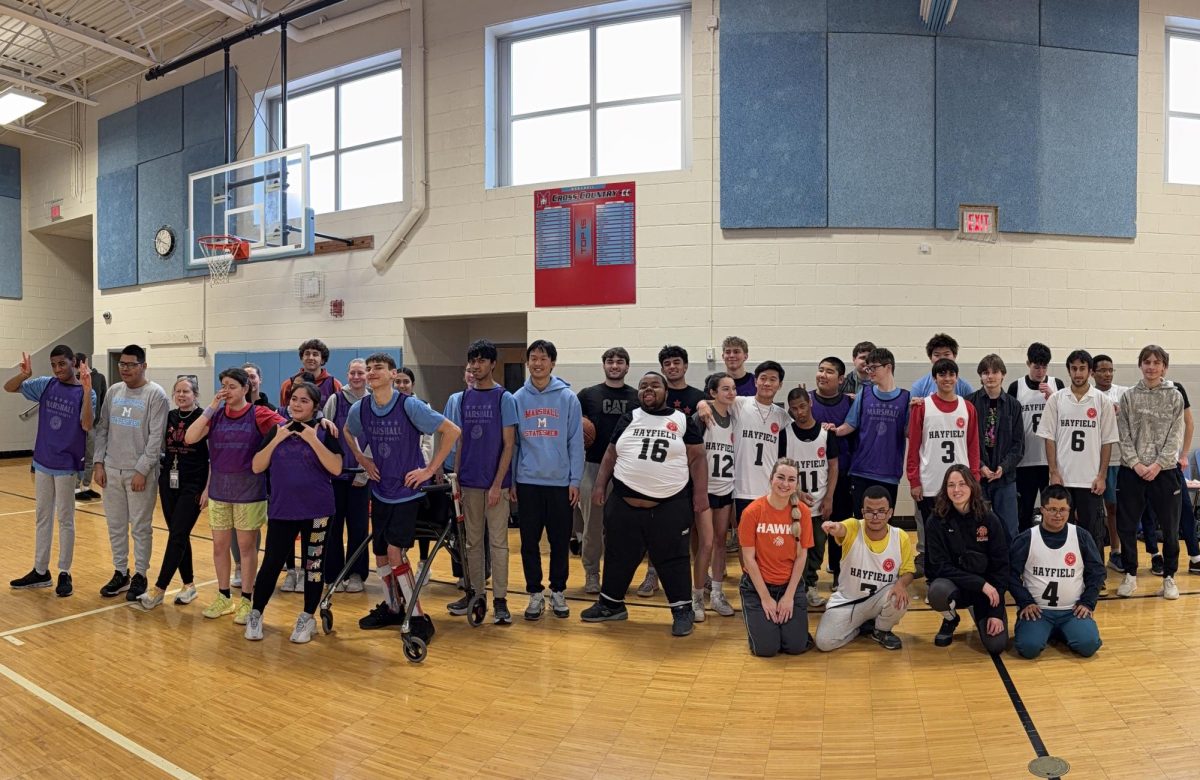
The Special Olympics is an internationally recognized organization that provides persons with intellectual disabilities an athletic outlet, ranging across 30 different sports. At Hayfield, this program took shape as a student-run club that had started in November, with junior Mary Duffey, president of the Special Olympics club, organizing a triad of basketball tournaments against Edison, Centreville, and Yorktown High School. There, general education volunteers play alongside students with disabilities, which is a component classified under unified sports.
“There’s the misconception that the only athletes allowed to play are those with disabilities in this context,” Hannah Hoffman, seventh grade health and physical education teacher and Special Olympic head coach, said. “So I think, at first, our volunteers weren’t sure what their role was, and then as we progressed, they got very comfortable. I know our athletes with disabilities. They felt so loved, they felt so supported. Anytime they scored, like, they got high fives, they got hugs.”
Building a positive and inclusive environment remained Hoffman’s priority throughout the games.
“I think sometimes inclusion is not always done correctly,” Hoffman said. “We sometimes introduce kids with disabilities into a setting, and they’re not offered support. And when you don’t offer them support, they’re not going to be successful. So having volunteers, specifically there, to give them prompts, give them encouragement, it gives them that courage and empowerment to do well.”
Emphasizing students’ needs first is a significant feat considering that the players’ passions and necessities do not exist under a single, general definition. For some, these regional games are the stepping stone for furthering athletic success at the state level. For others, it is a way to build confidence and friendships outside of the classroom. Responding accordingly, both Hoffman and Duffey communicate with each player and coach to make sure that their students’ individual needs are heard throughout the games, ensuring established common ground between teams.
“The way this has been structured this year is kind of the epitome of what inclusion should be,” Hoffman said. “The other team’s coaches would come up to me and ask, ‘How do you want to do this? Do you want to play competitive? Do you want to have more fun? How do you want to do the rules?’ And we were just willing to adjust anything to make every single kid more comfortable. We would also, like, take whistles away, ’cause we don’t want the loud sound to potentially trigger a student. So I think inclusion is just, they are playing a regular game of basketball, and we are just modifying the rules and the environment to make them as successful as they can possibly be.”
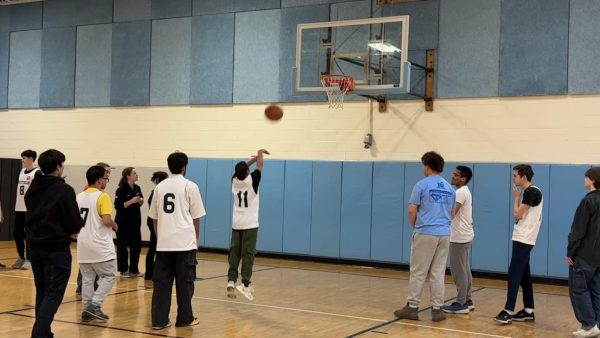
Putting the emphasis on the students through the Special Olympics and making the games accessible models a clear picture of acceptance and involvement of students with intellectual disabilities and consolidates this framework as precedent.
“Next year, we would like to add track in the spring and eventually expand to include soccer in the fall,” Daniel Drickey, Director of Student Activities, said. “Our goal with this program is to be recognized as a Special Olympics Unified Champion School, which is based on a commitment to inclusion across 10 standards of excellence.”
It’s clear the Special Olympics not only serves as many different types of refuges and outlets for all students, but it’s an expanding program in Hayfield that is only looking to grow and involve more students in its process.
“Seeing students with intellectual disabilities playing basketball side by side with able bodied students is refreshing and rewarding beyond counting,” Drickey said. “There is too much separation and divisiveness in the world today, so seeing these students playing, competing and learning from each other really warms your heart and improves your spirit.”