



Chemistry is something that is around us constantly and affects our daily lives in so many different ways, from cooking to cleaning our houses. Hayfield Secondary School hosted a science fair on Jan. 17 where students were assigned projects to design, test, and experiment with. Science is a subject learned in school, giving students the opportunity to create their projects.
“My project was about the efficiency of solar power energy and how it works in different weather conditions, like when it is sunny or cloudy, I wanted to see how solar power would perform depending on the weather,” sophomore Anneliz Rocha Torres said. “My original design was to test a fake toy solar-powered car and see how my experiment would go through different trials. I used multiple trials to compare how a solar car worked in different conditions.”
The main purpose of her project was to show how clean energy performs in real life, and what steps were taken to achieve that. However, the process was not easy.
“The hardest part of my project was putting all the data into a graph. I got different results in most of my trials, but I eventually found the average and figured out my percentages,” Torres said.
Although the process for the project wasn’t easy to come together, the student still pushed through and completed it.
“One judge said I should have added temperature percentages too. I agree, because that is something I probably should have included,” Torres said.
After presenting, the students received feedback helping them reflect and improve. Completing the experiment, students had mixed feelings about recommending it to other students.
“I feel neutral about the science fair. It was very fun to see other people’s projects and their creativity. Overall, this science fair has more educational purposes but is more forced onto students,” Torres said.
In contrast, another student took more of a hands-on approach.
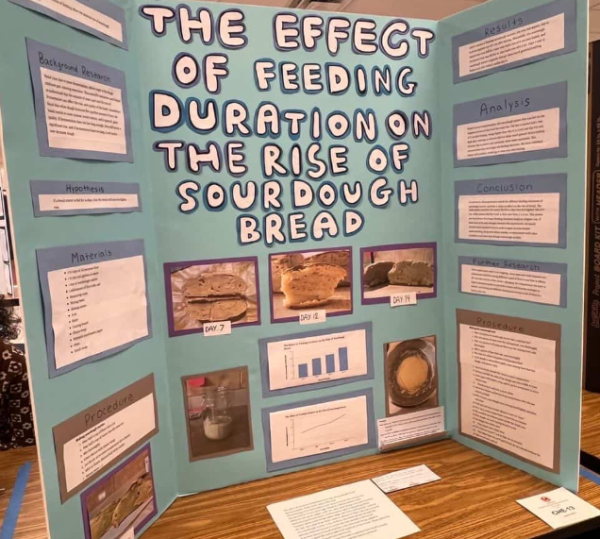
“My project was about the effect of feeding duration on the rise of sourdough and its connection to slower dopamine release. I studied how the feeding time of the sourdough starter affected the bread over time,” sophomore Amara Phe Rom said. “I started by baking a sourdough starter, and over 14 days continuously fed and discarded it while baking different sourdough batches. I tested the process over two weeks to see how feeding time changed the result.”
As the experiment progressed, there were some challenges that were time consuming.
“One of the hardest parts was making the actual sourdough bread because it almost took a whole day, designing the project’s board was really challenging,” Phe Rom said.
Regarding feedback, the judges prioritized the aesthetic design of the project rather than the taste of it.
“The judges mostly asked if I tried the bread and whether it was good,” Phe Rom said.
The science fair isn’t for everyone, instead, as one person said.
“It depends on the person. If someone isn’t very persevering or doesn’t enjoy research, I wouldn’t recommend it, but if you like that kind of work, then I would recommend,” Phe Rom said.
Moving to a different field, the third project offered a new perspective.
“My project was about the effect of red light and vibration on the growth of bacteria, I studied and observed how red light and vibration affects growth of bacteria,” sophomore Elly Freeman said. “To design my experiment I used agar plates and swabbed a mouth to harvest bacteria and then utilized a red light lamp and vibration plate to influence their growth.”
However, the process was not without difficulties, especially when you are limited.
“The hardest part was the lack of available resources and various limitations within my study. I was unable to quantify the bacterial colonies using alternative methods other than observing from the human eye,” Freeman said.
Following the judges recommendation was to focus on practical applications. Beyond just competition, though, this is also an opportunity for seeking both challenge and professional guidance.
“I would recommend the science fair to other students because it was a great experience and offered a way to test an idea and receive highly educated feedback,” Freeman said.
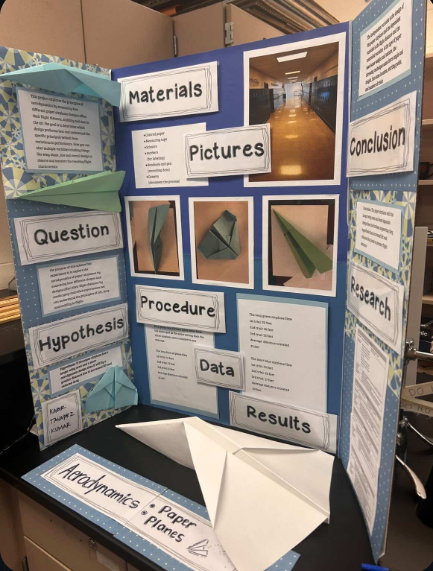
Another project analyzes the aerodynamic performance on paper airplanes.
“My project was about aerodynamics on paper airplanes,” Kabir Kumar said. “I made three different types of paper airplanes and tested each one three times, measuring the distance they traveled. Each airplane had a different design, such as wingspan or nose length.”
A major challenge that arose from doing this project was trying to be consistent.
“One of the hardest parts was throwing the airplanes with consistent power to get accurate results,” Kumar said.
Despite the challenges, he was successfully able to complete his project and get advice from judges.
“The judges suggested using a launcher so each airplane would be launched with the same force,” Kumar said. “I would recommend the science fair to others because there are so many topics you can explore, and it’s really fun.”
The science fair is an opportunity for students to test science and see the outcome result of their experiment. It’s a learning experience on how chemistry affects our lives and different things around us. It requires a lot of hard work, struggle and hardship to complete, but we gain a better understanding of things we never thought about before.